Key takeaways
- Harar Ethiopia holds 82 mosques and 102 shrines inside a 48-hectare walled town, one of the densest concentrations of Islamic heritage anywhere (UNESCO, 2006).
- Harar Jugol became a UNESCO World Heritage Site in 2006 and is often called the fourth holy city of Islam.
- The nightly hyena feeding ritual outside the old walls is a genuine local tradition maintained by experienced hyena men.
- Harar pairs well with the Danakil Depression and Erta Ale on an eastern Ethiopia loop from Dire Dawa.
Harar is a fortified old town in eastern Ethiopia, packed with 82 mosques and 102 shrines inside walls barely a kilometer across. Few places in the world concentrate this much religious history, street life, and craft tradition into so small a footprint, which is why Harar Ethiopia rewards travelers who slow down and wander.
The city sits on a plateau about 500 kilometers east of Addis Ababa. For centuries it was a crossroads where caravans, scholars, and merchants met. That legacy is still visible in the color-washed houses, the crowded markets, and a coffee culture that locals treat as daily ritual rather than tourist attraction.
What Makes Harar a Center of Islamic Scholarship and Trade?
Harar became one of the most important Islamic cities in the Horn of Africa, and UNESCO describes it as "considered 'the fourth holy city' of Islam" after Mecca, Medina, and Jerusalem (UNESCO World Heritage Centre). The walled town, known as Harar Jugol, holds 82 mosques, three of which date from the 10th century, plus 102 shrines packed into just 48 hectares.
That density is not an accident. From roughly the 13th century onward, Harar sat at the meeting point of trade routes linking the Ethiopian highlands, the Somali coast, and the Arabian Peninsula. Merchants brought goods; scholars brought books and religious learning. The city minted its own currency and produced a distinct written form of the local language.
Trade and scholarship reinforced each other for generations. Wealth from caravans funded mosques and religious schools, and those institutions drew students from across the region. Walking the old town today, you pass shrine after shrine tucked between homes, evidence of how deeply faith and commerce were woven together.
Harar also served as a hub for spreading Islam across the Horn of Africa. Local saints and teachers are still honored at the shrines scattered through Harar Jugol, and their tombs remain places of pilgrimage. The city gave rise to its own scholarly tradition in poetry, manuscript copying, and religious commentary, much of it produced in Harari, a Semitic language spoken almost nowhere else. That intellectual output is one reason the town punches so far above its size in regional history.
Exploring the Maze-Like Alleys and Colorful Old Town
The old town is a genuine labyrinth, with UNESCO counting 368 narrow alleyways squeezed into roughly one square kilometer. Getting a little lost is part of the experience, and the walls make it hard to stray too far.
Those walls give Harar Jugol its shape. The stone rampart stands about 5 meters high and runs some 3.5 kilometers around the town, built in the 16th century to defend against outside threats. Five original gates once controlled who came in and out. A sixth, the Harar Gate, was added in 1889 to ease growing traffic.
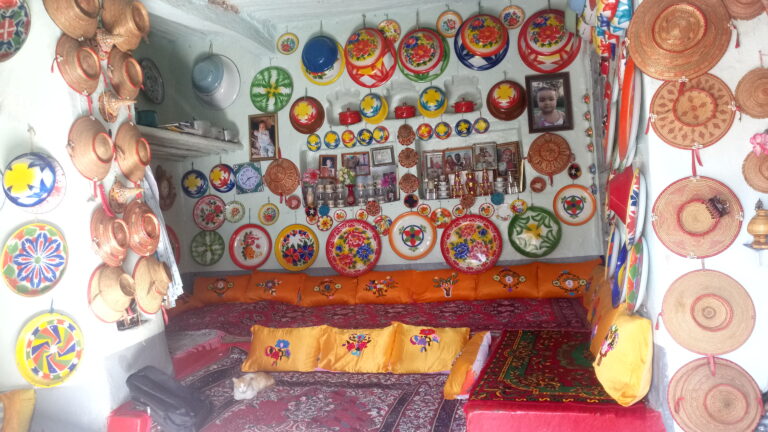
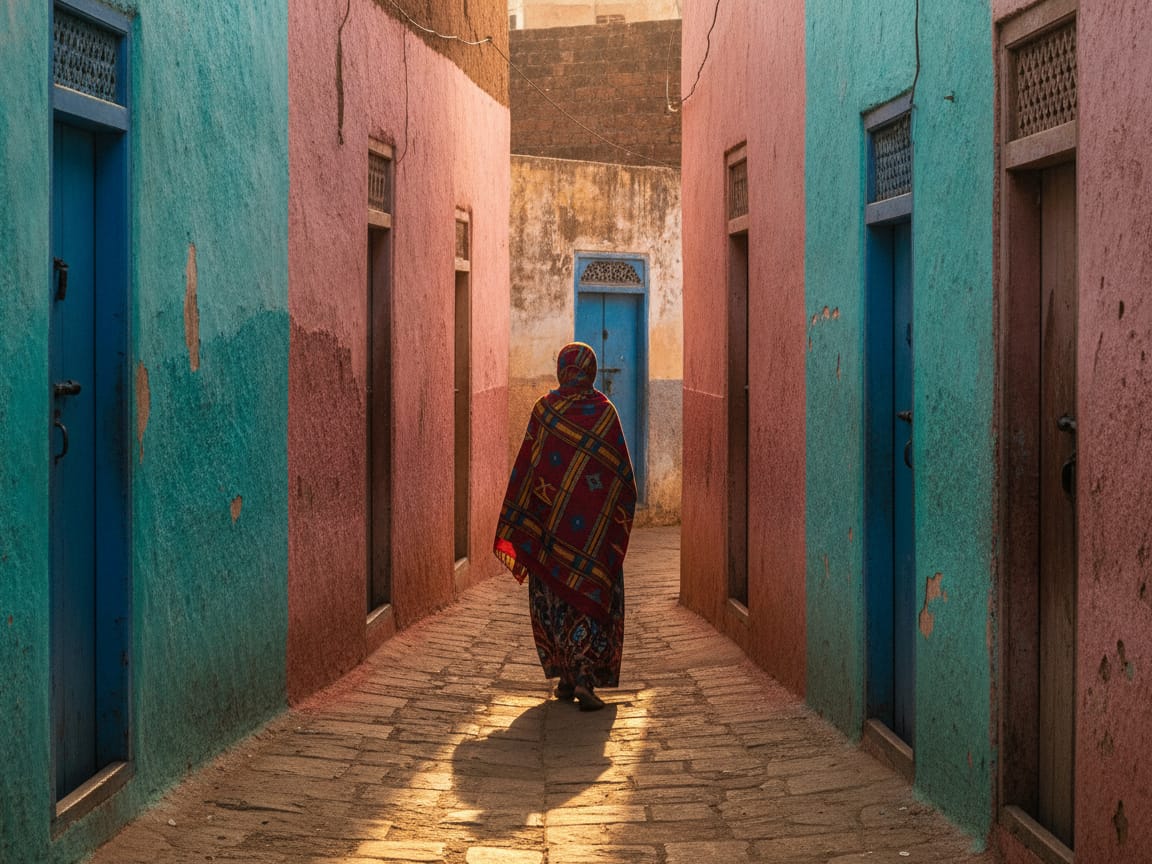
Inside, the houses are painted in bright greens, blues, and pinks. Doorways open onto small courtyards, and many traditional homes keep the classic Harari layout, with a raised sitting platform and walls lined with baskets and pottery. Hire a local guide for a couple of hours. The alleys twist without logic, and a guide turns a confusing walk into a story about who lived where and why.
Early morning and late afternoon are the best times to walk. The light softens the painted walls, children play in the lanes, and the crowds thin out. Some traditional houses open their doors to visitors, offering a look at the interiors that shaped the UNESCO listing. A few have become small museums or guesthouses, so you can even sleep inside the old walls and wake to the call to prayer echoing off the stone.
The Famous Hyena Feeding Tradition Explained
Every night, just outside the old walls, a local "hyena man" calls wild spotted hyenas by name and feeds them scraps of meat by hand, sometimes from a stick held in his mouth. Written records suggest the practice goes back at least 500 years (CNN). It is one of the most striking wildlife encounters anywhere in Africa.
The tradition has practical roots. Hyenas act as unofficial street cleaners, clearing scraps and carcasses from around the town. Locals have long tolerated and even welcomed them, and small openings in the old walls once let the animals slip in and out at night.
Visitors can sit close and, if they choose, hold a feeding stick under the hyena man's supervision. The animals remain fully wild, so the calm competence of the handlers matters. Watching them work, unhurried and familiar with each animal, tells you more about Harar's relationship with the surrounding land than any museum could.
Markets, Coffee, and Local Crafts to Experience
Harar's markets are the beating heart of daily life, and its coffee culture runs just as deep. The wider region is part of Ethiopia's coffee homeland, and a proper Harari coffee ceremony, with roasting, grinding, and slow brewing in a clay jebena pot, can stretch across an hour or more.
The ceremony works as a social invitation. A host roasts green beans over coals until the room fills with smoke, grinds them by hand, and serves three rounds of thick, strong coffee. Accepting all three is a sign of respect. Sit down for one and you will learn more about Harari hospitality in an hour than a guidebook can tell you.
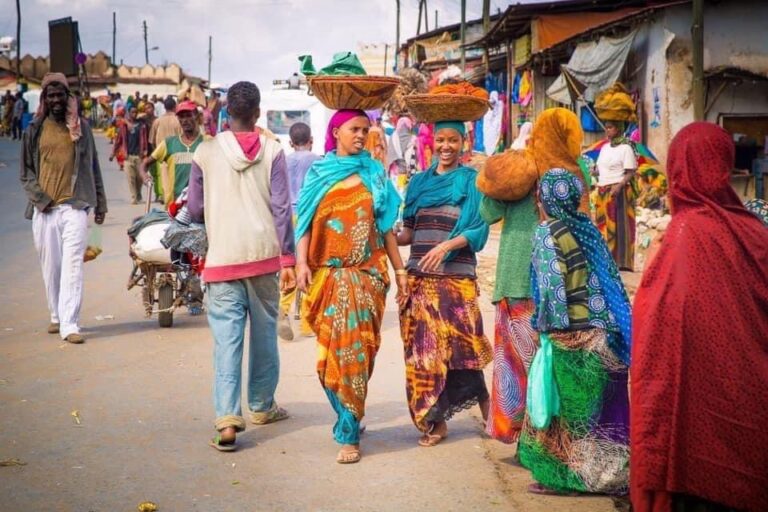
Spend a morning in the market. Traders sell spices, textiles, silver jewelry, and the famous Harari basketwork, woven in tight geometric patterns and prized across Ethiopia. The colors and noise are overwhelming in the best way, and prices are open to friendly bargaining.
Craft here is a living tradition passed down at home rather than staged for visitors. Buy directly from makers where you can. A hand-woven basket or a piece of Harari silver carries far more meaning than a mass-produced souvenir, and the money goes straight to the family that made it.
How to Include Harar Ethiopia in an Eastern Tour
Harar works best as an anchor for a wider eastern Ethiopia trip rather than a standalone day visit. Most travelers fly into Dire Dawa, the nearest airport, then drive about an hour uphill to the walled town. Two nights lets you cover the old town, the market, and one hyena feeding without rushing.
From Harar, the classic extension heads north toward the Danakil Depression, home to the Erta Ale lava lake, one of only a handful of permanent lava lakes on Earth. Combining Harar's cultural depth with the Danakil's raw geology makes for a striking contrast in a single loop.
Roads, permits, and timing in this region reward local knowledge. A ground operator handles the logistics that are hard to arrange from abroad: airport transfers, licensed guides inside Harar Jugol, and safe access to the Danakil. Yenew, the team behind GishAbay Ethiopia Tour, builds custom eastern Ethiopia itineraries that fold Harar into a longer route so you see the region as a connected journey. If you are still shaping the bigger picture, start with a complete Ethiopia trip starter guide, then decide where Harar fits.
The next step is simple: pick your travel window, decide how many days you can give the east, and map Harar against one natural-wonder extension like the Danakil. Once those anchors are set, the rest of an eastern Ethiopia itinerary falls into place around them.
Frequently asked questions
Where is Harar in Ethiopia?
Harar sits in eastern Ethiopia, roughly 500 kilometers east of Addis Ababa. Most travelers fly to nearby Dire Dawa, then drive about an hour uphill to the walled old town.
Why is Harar a UNESCO World Heritage Site?
UNESCO inscribed Harar Jugol in 2006 for its exceptional Islamic architecture, 82 mosques, 102 shrines, and the unique domestic layout of its traditional houses inside the 48-hectare walled town.
Is the hyena feeding in Harar safe to watch?
Yes. The hyena feeding happens nightly just outside the old walls under the guidance of experienced local hyena men. Visitors watch from close range and can feed the animals under supervision.
How many days do you need in Harar?
Two nights is comfortable. That gives you a full day inside the walled town, a morning at the market, and one evening at the hyena feeding without rushing.