Key takeaways
- Erta Ale sits at 613 meters in Ethiopia's Afar region and holds a lava lake active for at least 90 years (Oregon State Volcano World).
- You reach the volcano through the Danakil Depression, the hottest inhabited place on Earth with a 34.6°C average annual temperature.
- Permits, an armed escort and a licensed local tour operator is mandatory for the trek to the rim.
- Pack for extreme heat by day, thin mattress camping at night, and thick volcanic fumes near the crater.
- Most travelers combine Erta Ale with Dallol's mineral springs and the Danakil salt flats in one loop.
Erta Ale is an active shield volcano in Ethiopia's Afar region that guards one of the planet's rarest sights: a lake of molten lava that never fully cools. Reaching it means crossing the Danakil Depression, camping on a live crater rim, and trekking under extreme heat, which is exactly why the Ethiopia volcano Erta Ale draws adventure travelers who want more than a viewpoint. This guide walks through what makes the lava lake so unusual, how to get there, the permits and safety rules that apply, what to pack, and how to fold in Dallol and the salt flats.
Key Takeaways
Erta Ale sits at 613 meters and holds a lava lake active for at least 90 years (Oregon State Volcano World).
Access runs through the Danakil Depression, the hottest inhabited place on Earth at 34.6°C average.
Permits, an armed escort and a licensed guide are required for the trek.
Pack for scorching days, basic rim camping at night, and heavy volcanic fumes.
Erta Ale pairs naturally with Dallol and the salt flats in one loop.
What Makes the Erta Ale Lava Lake So Rare?
Erta Ale's lava lake has been active for at least the last 90 years, a persistence almost no other volcano on Earth can match (Oregon State University Volcano World). Most volcanoes erupt and then fall dormant. Here, molten rock stays visible in the summit crater year after year, which is why volcanologists treat the site as a natural laboratory.
Only a handful of persistent lava lakes exist worldwide at any given time. That short list makes Erta Ale one of the few places where you can stand near open molten rock rather than study old flows. The volcano itself is broad and low, rising to 613 meters above sea level, more a wide dome than a jagged cone.
The name Erta Ale means "smoking mountain" in the local Afar language, and the description fits. Sulfurous gas rises off the crater, and at night the lake glows deep red against the dark. For travelers, that glow is the whole reason to make a hard journey into one of the most remote corners of the country.
How Do You Reach Erta Ale Through the Danakil Depression?
Getting to the Ethiopia volcano Erta Ale means driving deep into the Danakil Depression, the hottest inhabited place on Earth, where the average annual temperature reached 34.6°C between 1960 and 1966 (Wikipedia, Dallol). There are no direct roads to the rim, so the trip is built around 4×4 vehicles and a final walk on foot.
Most journeys begin in Mekele, a highland city with an airport. From there, vehicles descend hundreds of meters over several hours onto the desert floor. The landscape shifts from green highlands to black basalt and pale salt in a single drive. A base camp sits at the foot of the volcano, and the trek to the crater usually starts in the late afternoon or evening to escape the worst heat.
The walk to the rim covers rough volcanic ground and takes roughly three to four hours at a steady pace. Guides time it so you reach the summit around dusk, when the lava lake shows best. Camels or porters often carry gear and water, since carrying a full pack across sharp lava in that heat is punishing. If you are weighing this trek against Ethiopia's other landscapes, our guide to Ethiopia tour packages helps match a route to your fitness and time.
What Safety, Guides and Permits Does the Trek Require?
Erta Ale is not a place you visit alone. A licensed local guide, an armed escort and an official permit are standard requirements, arranged before you set out. The Afar region borders sensitive areas, and past security incidents mean travel is organized in escorted convoys rather than independent hikes.
Beyond security, the volcano carries real natural hazards. This is a live vent. Between January 2017 and March 2020, fissure eruptions on Erta Ale sent lava flows across roughly 30 square kilometers, reshaping the summit area (NASA Earth Observatory). Crater edges can be unstable, and toxic gas concentrations rise without warning, so you stay behind your guide and away from the lake margin.
Heat is the other constant threat. Dehydration and heat exhaustion put more travelers at risk here than the lava does. Reputable operators cap group sizes, carry extra water, and monitor current volcanic activity before committing to the rim. Booking through an experienced Ethiopian operator such as Yenew means the permits, escort and logistics are handled as one package rather than pieced together on arrival.
What Should You Pack for Heat and Rim Camping?
Pack for two extremes at once: brutal daytime sun and a rough night on an exposed crater rim. The single most important item is water, far more than you think you need, followed by electrolyte salts to replace what you lose sweating in the Danakil heat.
For the trek and overnight, prioritize this short list:
- Lightweight, long-sleeved clothing to shield skin from sun and volcanic grit
- Sturdy closed hiking boots, since the lava rock is sharp and uneven
- A headlamp with spare batteries for the night approach and camp
- A wide-brimmed hat, high-SPF sunscreen and wraparound sunglasses
- A thin sleeping mat or liner; camps supply basic bedding, not comfort
- A buff or mask to filter dust and sulfurous fumes near the crater
Nights on the rim are warm but breezy, and you sleep on simple mattresses under the open sky rather than in tents. Charge every device beforehand, because power is scarce. A dry bag keeps electronics safe from grit, which gets into everything out on the salt and ash.
Physical readiness matters as much as gear. The trek is not technical, but heat plus a multi-hour walk on rough ground tests most people. If you want to build stamina on gentler terrain first, our Simien Mountains trekking guide covers routes that make a good warm-up earlier in a trip.
How Do You Combine Erta Ale With Dallol and the Salt Flats?
Erta Ale rarely stands alone on an itinerary. Because the volcano, Dallol's hydrothermal field and the Danakil salt flats all lie within the same depression, operators bundle them into a single three to four day loop, which spreads the driving and the cost across several highlights.
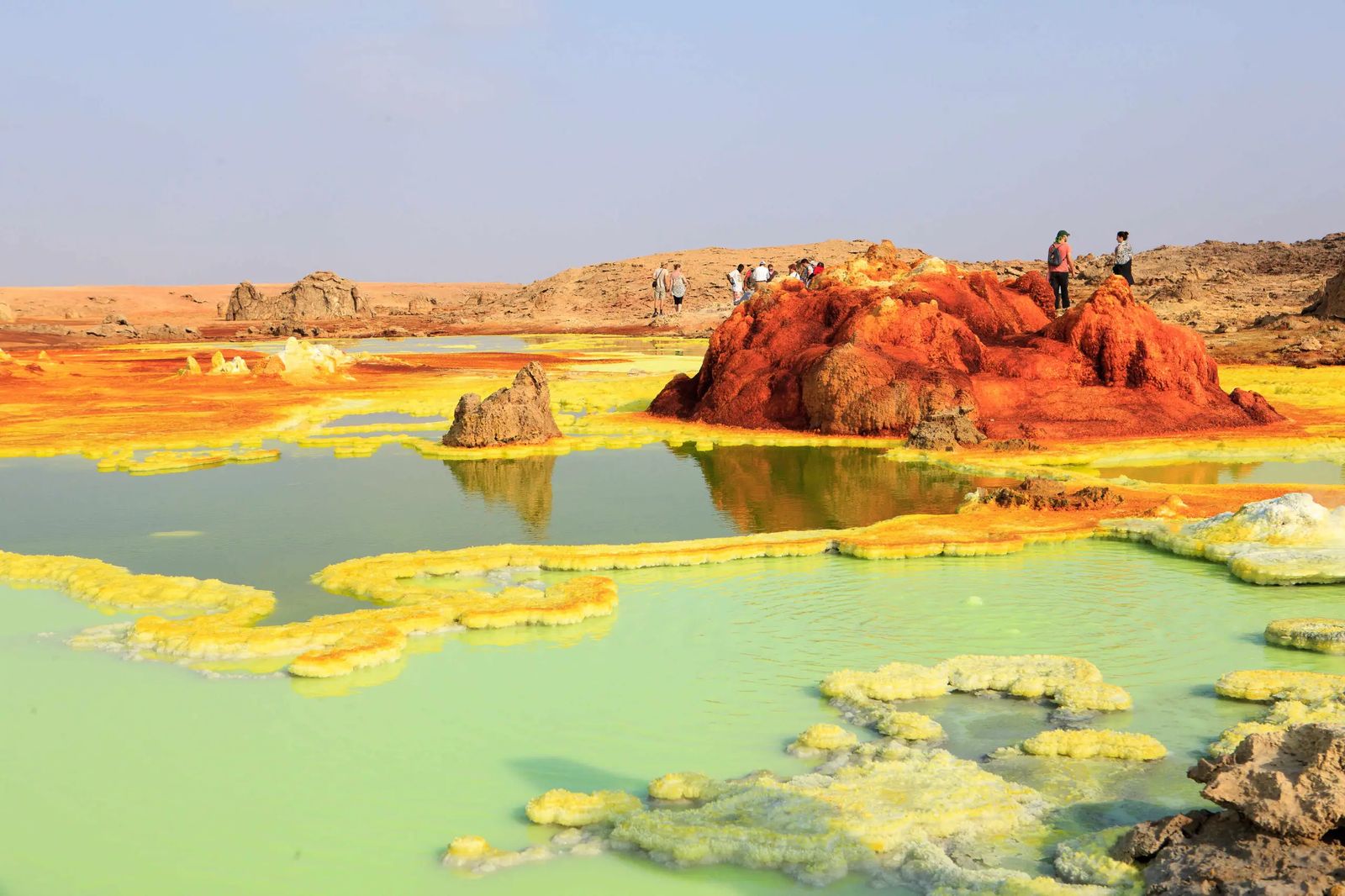
Dallol is the visual opposite of the black lava lake: a field of neon yellow, green and orange mineral springs bubbling over salt. It sits at one of the lowest points on the continent, and the acidic pools make it one of the strangest surfaces on Earth. A short drive away, Afar salt miners still cut blocks from the flats by hand and load them onto camel caravans, a trade that has run for centuries.
A typical loop drives from Mekele to Erta Ale first, treks the volcano overnight, then moves to Dallol and the salt flats on the return. Combining them makes sense logistically and turns a single-sight trip into a full desert expedition. Travelers who catch the science and culture bug here often extend into the highlands afterward, whether toward rock-hewn churches or the tribal south, both covered in our wider Ethiopia guides.
Planning Your Erta Ale Trip
The next practical step is to lock in your travel window and operator early. The comfortable months run from November to February, and permits and escorts for the Danakil route are limited, so popular dates fill fast. Decide how many days you can give the depression, confirm current volcanic and security conditions with a licensed Ethiopian operator, and book the Erta Ale trek as part of a Danakil loop rather than a standalone day trip. That single decision, made a few months out, is what turns a difficult logistics puzzle into a smooth expedition to one of the rarest sights on the planet.
Frequently asked questions
Is it safe to visit Erta Ale?
Yes, with a licensed guide, an armed escort and a permit. The Afar region has seen past security incidents, so travel is organized in escorted convoys and conditions should be checked before you book.
How high is the Erta Ale volcano?
Erta Ale rises to 613 meters above sea level in Ethiopia's Afar region, according to Oregon State University's Volcano World. It is a broad shield volcano rather than a steep peak.
How do you get to Erta Ale's lava lake?
Most trips start in Mekele, drive across the Danakil Depression, then trek several hours on foot to the crater rim, usually at night to avoid the heat, and camp on the rim.
What is the best time to visit Erta Ale?
The cooler, drier months from November to February are most comfortable. Even then daytime heat is intense, so overnight treks are timed around dusk and dawn.
Can you see lava at Erta Ale?
Yes. Erta Ale holds one of the world's few persistent lava lakes, glowing molten rock that has been active for at least 90 years, though the lake level and visibility vary over time.