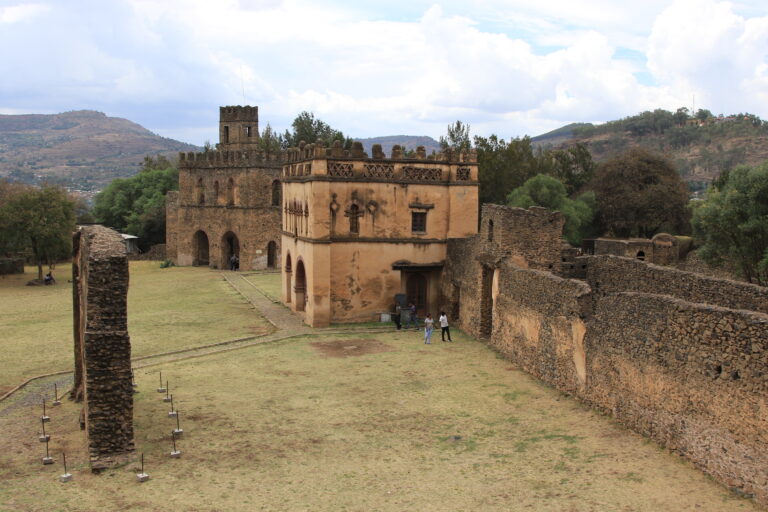
Key takeaways
- Gondar's castles sit inside Fasil Ghebbi, a royal enclosure founded in 1636 by Emperor Fasilides and inscribed by UNESCO in 1979.
- The compound is ringed by a 900-metre wall and holds palaces, churches, and monasteries built over roughly two centuries of Gondarine rule.
- Debre Berhan Selassie church is famous for a ceiling covered in rows of winged angel faces, one of Ethiopia's most photographed interiors.
- Fasilides' Bath fills once a year for Timkat, the Ethiopian Orthodox Epiphany, recognized by UNESCO as intangible cultural heritage in 2019.
- Gondar fits naturally into a northern historic circuit alongside Lalibela, Axum, and the Simien Mountains.
Gondar castles are the stone palaces of Fasil Ghebbi, a walled royal enclosure that Emperor Fasilides founded in 1636 and that UNESCO added to its World Heritage List in 1979. You can walk the whole compound in a morning, see the towers, banqueting halls, and churches built by generations of emperors, and understand why people call this the capital that made Ethiopia's highland baroque.
Gondar sits in the Amhara highlands of northern Ethiopia. For more than two centuries it was the seat of imperial power, and the buildings left behind read like a timeline in stone. This guide walks through the enclosure, the emperor who started it, the painted church nearby, the bath that comes alive once a year, and how to fit it all into a northern tour.
The story of the Fasil Ghebbi royal enclosure
Fasil Ghebbi means "the compound of Fasilides" in Amharic, and that name tells you where the story begins. Before Gondar, Ethiopian emperors ruled from moving camps, shifting the court from place to place. Fasilides broke that pattern in 1636 by choosing a fixed capital, and the enclosure grew from a camp into a fortified city.
A wall roughly 900 metres long rings the site, pierced by twelve gates and crossed by bridges. Inside are palaces, churches, monasteries, and service buildings raised by Fasilides and the rulers who followed him. UNESCO inscribed the property in 1979 under cultural criteria that recognize both its blend of influences and its testimony to Gondarine civilization, according to the UNESCO World Heritage Centre.
The architecture is what surprises first-time visitors. You see local Aksumite building traditions mixed with Portuguese, Indian, and later Baroque touches brought by Jesuit missionaries. The result looks unlike anything else in Africa, which is how Gondar earned its nickname as the Camelot of Africa. If church architecture is what draws you here, it helps to read up on Ethiopian churches and their faith, art, and architecture before you go.
Give yourself time to walk the grounds slowly. The buildings sit at different distances across the compound, connected by grass, low walls, and the remains of old passageways, so the site rewards wandering rather than a quick loop. Morning light is kind to the stonework, and the crowds are thinner before the tour buses arrive. Bring water, a hat, and comfortable shoes, because the ground is uneven and there is little shade between structures.
The main Gondar castles and the legacy of Emperor Fasilides
Fasilides reigned from 1632 to 1667, and his castle is the one most photographs show: a tall stone structure with domed towers, battlements, and a rooftop terrace that looks out over the city. It set the template. Every emperor who added a building was, in a sense, answering the one Fasilides built first.
The enclosure holds several distinct structures worth naming as you walk through:
- The Castle of Emperor Fasilides, the oldest and most striking, with its rounded corner towers.
- The Castle of Emperor Iyasu, once richly decorated inside.
- The Library and Chancellery of Tzadich Yohannes, quieter buildings tied to administration and learning.
- The Palace of Empress Mentewab and the Banqueting Hall of Emperor Bekaffa, from the later Gondarine period.
Gondar stayed the center of Ethiopian government until 1864, when power moved elsewhere. That long run, roughly two hundred years of continuous royal building, is why the compound feels layered rather than uniform. A good guide will point out how styles shift from one reign to the next, and that context turns a set of ruins into a readable history.
Debre Berhan Selassie church and its famous ceilings
A short walk from the main enclosure stands Debre Berhan Selassie, the church that most visitors remember longest. Its name means "Mountain of the Enlightened Trinity," and its plain exterior gives no hint of what waits inside.
The ceiling is the reason people come. It is covered, edge to edge, with rows of winged angel faces, each with wide almond-shaped eyes, gazing down on everyone below. The effect is unusual and calm, and it has made this one of the most photographed church interiors in the country. The walls carry biblical scenes painted in the bold, flat style of the Gondarine school, with saints, apostles, and scenes from the life of Christ arranged in registers that a guide can walk you through panel by panel.
Photography rules can change, so ask before you raise a camera, and expect flash to be off-limits to protect the paintings. Give the interior a few minutes for your eyes to adjust to the low light. The longer you stand under the ceiling, the more individual faces you start to pick out, and that slow reveal is part of what makes the visit stick with people.
Debre Berhan Selassie survived when other churches in the region did not, and local tradition credits its protection to a swarm of bees that drove off attackers. Whether or not you take the legend literally, the church is a living place of worship, so dress modestly and remove your shoes before entering.
Fasilides' Bath and the Timkat celebrations
On the northern edge of town sits Fasilides' Bath, a large rectangular stone pool surrounded by a wall, with a small building set on the water like a miniature castle. For most of the year the pool sits empty and the old fig trees have wrapped their roots into the surrounding stone. Once a year, that changes completely.
For Timkat, the Ethiopian Orthodox celebration of Epiphany, the pool is filled and the site becomes the heart of one of Ethiopia's biggest festivals. Priests carry the tabot, a replica of the Ark of the Covenant, in procession from the city's churches. Crowds keep an overnight candlelit vigil, the water is blessed at dawn, and young men leap into the pool in a re-enactment of baptism. UNESCO added Timkat to its Representative List of the Intangible Cultural Heritage of Humanity in 2019.
Timkat usually falls around January 19 (January 18 for the eve), so if the festival is your goal, plan for mid-to-late January and book early, because Gondar fills up. The days around Timkat are the single busiest window of the year for hotels and flights, and the festival draws visitors from across the country and abroad.
How to explore Gondar within a northern circuit tour
Gondar rarely stands alone on an itinerary. It anchors the northern historic circuit, the classic route through Ethiopia's highland heritage. Most travelers reach Gondar by a short domestic flight or by road, and one full day is enough for the castles, Debre Berhan Selassie, and Fasilides' Bath. A second day lets you slow down and add nearby monasteries.
From Gondar, the natural next steps are close at hand:
- North to the Simien Mountains for trekking, wildlife, and dramatic ridgelines, often just a few hours away.
- Onward to Lalibela and its rock-hewn churches, the highlight for many northern trips.
- Toward Axum for the older layer of Ethiopian history.
Because the distances and logistics add up, most visitors travel this circuit with a local operator rather than piecing it together alone. Yenew, at GishAbay Ethiopia Tour, builds Gondar into guided northern itineraries and handles the flights, permits, and local guides who can read the walls for you. If you are still shaping your route, decide how many days of the north you want before you lock in dates.
The single best move now is to choose your travel window. If Timkat matters to you, aim for January and reserve early. If you would rather have the castles quiet and the weather dry, target October through March and give Gondar a comfortable day and a half before continuing into the Simien highlands.
Frequently asked questions
Who built the castles in Gondar?
Emperor Fasilides founded Gondar in 1636 and built the first castle. His successors added more palaces, churches, and monasteries inside the same royal enclosure over the next two centuries.
Is Gondar a UNESCO World Heritage Site?
Yes. The Fasil Ghebbi royal enclosure in Gondar was inscribed on the UNESCO World Heritage List in 1979 under cultural criteria (ii) and (iii).
What is Debre Berhan Selassie church known for?
It is known for its ceiling, which is covered with rows of painted winged angel faces looking down on visitors. It is one of the most recognizable church interiors in Ethiopia.
When is the best time to visit Gondar?
The dry months from October to March are most comfortable. For the Timkat celebration at Fasilides' Bath, plan around mid-to-late January.
How long do I need in Gondar?
One full day covers the main castles, Debre Berhan Selassie, and Fasilides' Bath. Two days let you slow down and add nearby sites without rushing.