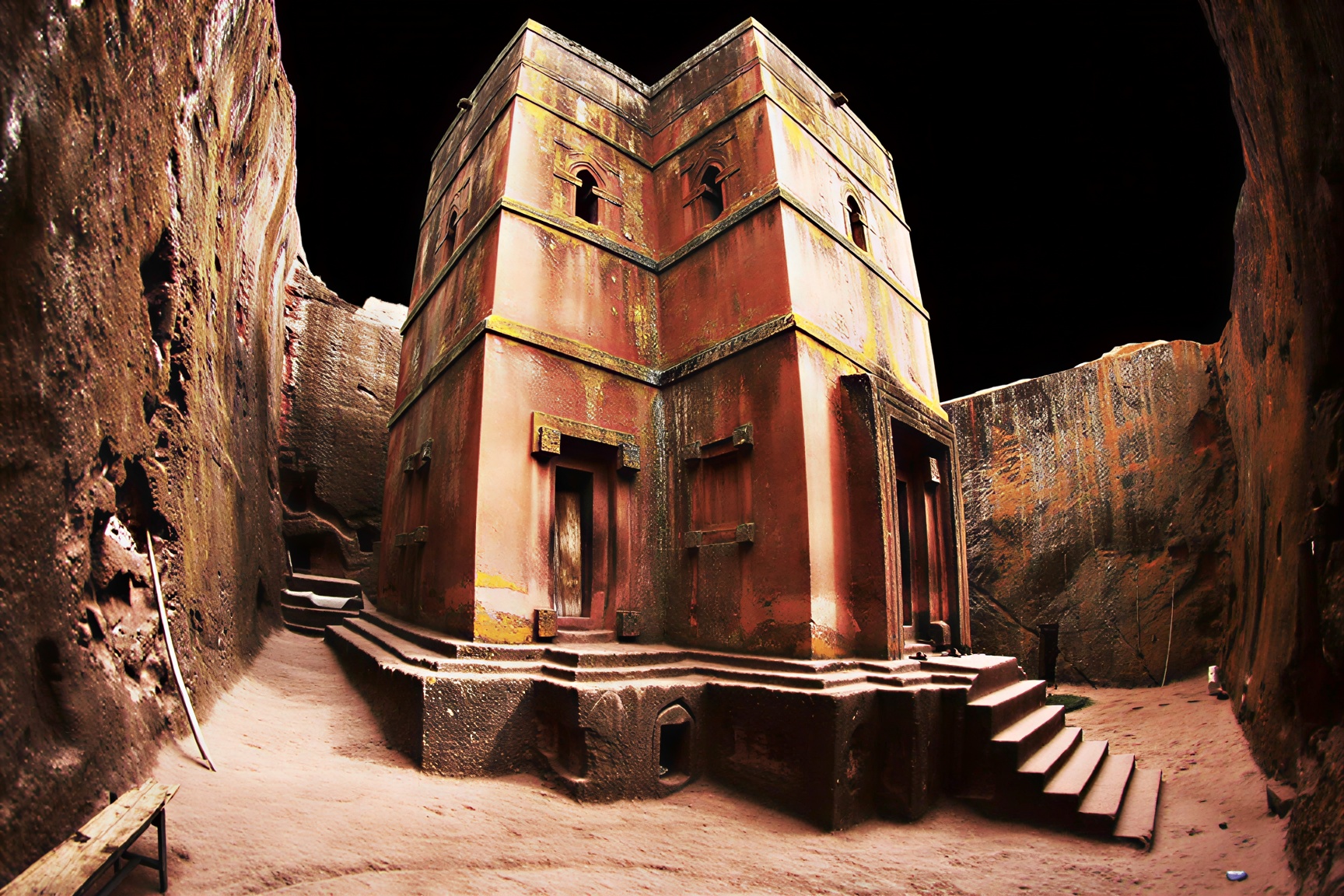
Lalibela is one of Ethiopia’s archaeological gems, often called the African Jerusalem. It has a group of rock-hewn churches, cut entirely from the rock, that emerge from the surface of the ground.
The churches sit within a network of galleries and underground passages. These lead to open-air courtyards, and in the centre of each rises a church. Basilica, cross-shaped church or simple chapel, each has its own architecture and decoration.
King Lalibela
The site is attributed to King Lalibela, who reigned at the turn of the 12th and 13th centuries. Lalibela illustrates Ethiopia’s part in a wider Christian tradition of recreating a small Jerusalem in the kingdom, as a symbol of divine election.
Earlier origins
The site existed before his reign. The first excavations were galleries and underground cavities beneath the rocky dome. Monumental freestone structures were built between the 10th and 11th centuries, and vast underground rooms connected to them.
The purpose of these spaces is still largely unknown. They show long experience of working in stone, which was needed to carve entire monolithic buildings.
Under King Lalibela, one to two centuries later, the old rooms were turned into chapels and the churches were cut from the rock. The debris from the new excavations was dumped over the earlier works.