Key takeaways
- The Danakil Depression is one of Earth's lowest and hottest inhabited regions, sitting well below sea level in Ethiopia's Afar zone.
- Dallol's mineral springs, the Lake Assale salt flats, and the Erta Ale lava lake are the three signature sights on most itineraries.
- A Danakil tour is only safe as a guided 4×4 expedition with a local operator, permits, water, and support vehicles.
- Pack for extreme heat: sun protection, electrolytes, sturdy boots for lava fields, and a light layer for cold desert nights.
- Most trips combine Dallol and the salt flats with an overnight climb to Erta Ale over three to four days.
A Danakil Depression tour takes you to a stretch of northern Ethiopia that records the highest average annual temperature of any inhabited place on the planet. You come here for neon acid springs, a salt desert crossed by camel caravans, and one of the few volcanoes on Earth with a permanent lava lake. This guide covers what makes the region so extreme, the sights worth your time, how to fold in the Erta Ale volcano, and the practical steps to join a guided expedition safely.
The Danakil sits in the Afar zone, part of the Afar Triple Junction where the Arabian, Nubian, and Somalian tectonic plates pull apart. That slow tectonic tearing is why the land dropped so far below sea level and why heat, salt, and volcanic activity all collect in one place.
What Makes the Danakil One of the Planet's Most Extreme Places
The reputation is earned. At Dallol, the average annual temperature reached 34.6 degrees Celsius (94.3 degrees Fahrenheit) over the years it was measured, the highest year-round average for any inhabited location, according to reference data compiled at geology.com. Daytime highs regularly push past 40 degrees Celsius, and summer can top 49 degrees.
The heat is only half the story. Much of the depression lies below sea level. The Dallol crater sits around 82 metres below sea level, and the deepest parts of the basin reach roughly 125 metres down. That low elevation, combined with almost no rainfall, traps heat and creates the furnace-like conditions the region is known for.
Underneath it all is active geology. The Afar region is one of the few places on land where you can watch continental rifting happen. As three plates separate, magma rises close to the surface, feeding volcanoes and the geothermal fields that give Dallol its colors.
Highlights: Dallol Sulphur Springs, Salt Flats, and Camel Caravans
Three sights carry most Danakil itineraries, and each one looks like nowhere else on Earth.
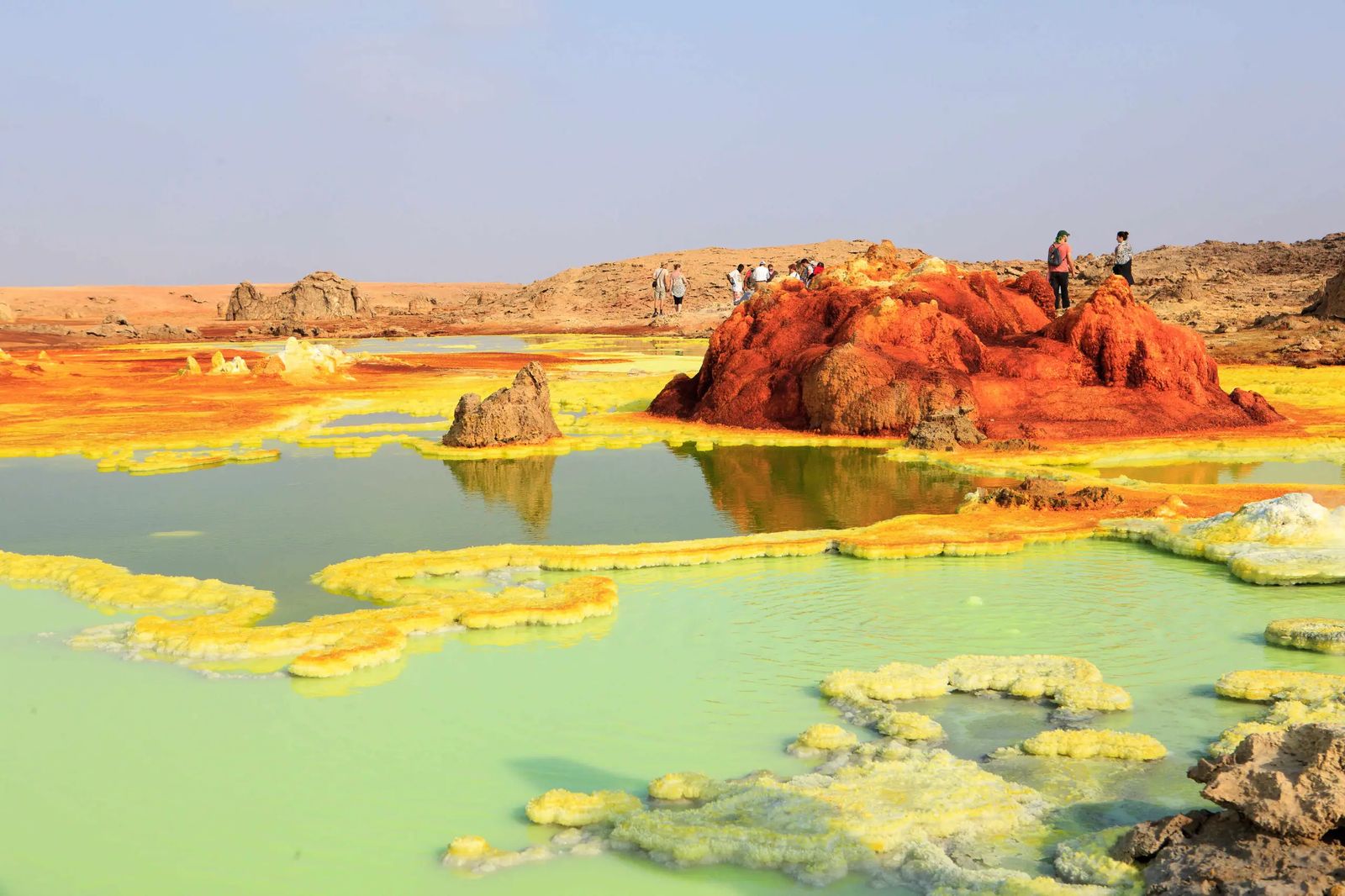
Dallol's hydrothermal field. This is the postcard image of the Danakil: pools and mounds in acid yellow, green, orange, and rust red. The colors come from iron and other minerals oxidizing as hot, briny water reaches the surface. The springs are hyperacidic and searingly hot, so you walk carefully and stay with your guide. It is one of the strangest short walks in African travel.
The salt flats at Lake Assale. South of Dallol, a vast white plain of salt stretches to the horizon. The salt was left behind by ancient floods from the Red Sea, and Afar workers still cut it into slabs by hand. At sunrise and sunset the flats turn mirror-smooth and golden.
The camel caravans. For generations, Afar salt miners have loaded slabs onto long trains of camels and driven them up toward the highland markets. Watching a caravan cross the white flats in the low sun is one of the defining scenes of the trip, and a reminder that people have lived and worked in this heat for centuries.
If you are still shaping a wider route through the country, it helps to slot the Danakil into a broader plan alongside the northern historical circuit and other regions.
Combining Danakil With the Erta Ale Volcano
Almost no one visits the Danakil for the springs alone. The other reason to come is Erta Ale, a shield volcano rising to 613 metres in the same Afar region and home to one of the world's longest-lived lava lakes. Very few volcanoes anywhere hold an open, persistent lake of molten rock, and Erta Ale is one of them.
Reaching it is a small expedition in itself. Most tours drive to a base near the volcano, then trek to the crater rim, usually in the cooler evening hours or overnight, to see the lava glowing against the dark. You typically sleep rough near the summit on simple bedding and descend before the morning heat builds.
Because the volcano is remote and conditions change, this leg needs an experienced operator and up-to-date safety information. Our dedicated Erta Ale lava lake adventure guide covers the climb, the overnight setup, and what to expect at the crater in more detail.
Most travelers combine both sights in a single three to four day loop: Dallol and the salt flats on the first days, then Erta Ale for the finale.
Health, Safety, and What to Pack for the Heat
The Danakil rewards preparation and punishes improvisation. The single biggest risk is the heat itself, so plan around it.
Health and safety basics:
- Hydrate constantly. Carry more water than you think you need and add electrolytes. Dehydration comes on fast in this climate.
- Cover up from the sun. A wide-brim hat, long light layers, sunglasses, and high-SPF sunscreen do more than any single item of gear.
- Respect the ground. Dallol's crusts can be thin and acidic, and Erta Ale's lava fields are sharp and uneven. Stay on the routes your guide chooses.
- Travel in a convoy. Reputable trips run with multiple 4×4 vehicles, local Afar guides, and, in some areas, a police or military escort arranged through your operator.
- Check current advisories. Conditions in the Afar border zone can shift, so rely on an operator who monitors the situation.
What to pack:
- Sturdy closed hiking boots for the lava fields and salt crust
- A light long-sleeve shirt and trousers for sun and dust
- A headlamp for the night climb on Erta Ale
- A thin sleeping layer, since desert nights can turn surprisingly cold
- Wet wipes and a scarf or buff for the salt and dust
- A power bank, as there is no electricity in the field
This is not a trip to attempt alone. Its remoteness, heat, and border-zone location are exactly why a guided, well-provisioned expedition matters.
How to Join a Guided Danakil Depression Expedition
A Danakil Depression tour works best as a packaged expedition rather than a do-it-yourself trip. Access requires local permits, Afar community arrangements, 4×4 transport, camping logistics, and guides who know the terrain, and a licensed operator handles all of it.
Here is a simple way to book with confidence:
- Choose a specialist operator. Look for a company that runs the Afar circuit regularly and can speak in detail about permits, safety, and current conditions. As a locally based Ethiopian operator, Yenew organizes guided Danakil and Erta Ale expeditions with the vehicles, guides, and support the region demands.
- Confirm what is included. Check that water, meals, camping gear, permits, guides, and any required escort are part of the price so there are no surprises in the desert.
- Pick the right season. Aim for the cooler months of November to February. The heat is still intense, but it is the most manageable window.
- Set your itinerary length. Three days covers the highlights; four days gives you a calmer pace and more time on Erta Ale.
If you want to weigh operators carefully, our guide on how to pick the best Ethiopia travel agency lays out the questions worth asking before you commit.
Ready to stand at the edge of a lava lake and walk across a landscape that looks like another planet? Reach out to a specialist Danakil operator, lock in a cooler-season departure, and let them handle the permits and logistics so you can focus on the experience.
Frequently asked questions
How many days do you need for a Danakil Depression tour?
Most guided trips run three to four days, which is enough to see Dallol, the Lake Assale salt flats, and the Erta Ale lava lake with a night on the volcano.
When is the best time to visit the Danakil Depression?
November to February is the coolest and most comfortable window. Even then daytime heat is severe, and the summer months are dangerously hot.
Is a Danakil Depression tour safe?
It is safe when you travel with a licensed operator that arranges permits, local guides, water, and convoy support. Independent travel here is strongly discouraged.
Can you combine Danakil with the Erta Ale volcano?
Yes. Erta Ale sits inside the same Afar region, and nearly every multi-day Danakil itinerary includes an overnight trek to its lava lake.