

Key takeaways
- The Gurage are one of Ethiopia's larger ethnic groups, counted at 1,859,831 people in the 2007 national census.
- Enset, the false banana, is the staple crop behind kocho bread and feeds roughly 20 million Ethiopians nationwide.
- Kitfo, finely minced raw beef spiced with mitmita and niter kibbeh, is the dish most associated with Gurage cooking.
- The Gurage Zone sits in Ethiopia's central highlands, about a three-hour drive southwest of Addis Ababa toward Wolkite.
The Gurage are an Ethiopian people of the central highlands, famous for a banana-like crop called enset, for the spiced raw-beef dish kitfo, and for a reputation as some of the country's most industrious traders and warmest hosts. If you have eaten in an Ethiopian restaurant and ordered kitfo, you have already tasted Gurage cooking. This guide explains who the Gurage people are, how they live, what they eat, and how to visit their highlands.
Ethiopia counts more than 80 ethnic groups, and the Gurage sit among the larger ones. In the 2007 national census, the most recent completed count, the population was recorded at 1,859,831 (Immigration and Refugee Board of Canada, citing Ethiopia's Central Statistics Agency, 2019). That makes Gurage culture a significant thread in the national story, even though their home zone is compact.
Who Are the Gurage and Where Is the Gurage Zone?
The Gurage are a Semitic-speaking farming people whose homeland, the Gurage Zone, sits in Ethiopia's central highlands southwest of the capital. The zone covers roughly 5,900 square kilometers, with the town of Wolkite as its administrative center (Wikipedia, Gurage Zone, retrieved 2026-10-06). Terraced green hills rise above 3,000 meters here, and Mount Gurage tops out over 3,500 meters.
Gurage languages belong to the South Ethio-Semitic branch, related to Amharic and to the ancient liturgical language Ge'ez. Historically the Gurage were not a single kingdom but a cluster of communities sharing farming methods, food, and social customs. Many Gurage have migrated to Addis Ababa and beyond for trade, which is one reason their food and reputation travel far ahead of their small highland territory.
What Do the Gurage Eat? Enset, Kocho, and Kitfo
The Gurage diet rests on three pillars: enset for everyday bread, meat for feast days, and the spiced raw beef called kitfo. Enset, often called the false banana, looks like a banana plant but is grown for its starchy stem and root rather than its fruit. Across southern and central Ethiopia, enset is a staple food for roughly 20 million people (Royal Botanic Gardens Kew, retrieved 2026-10-06).
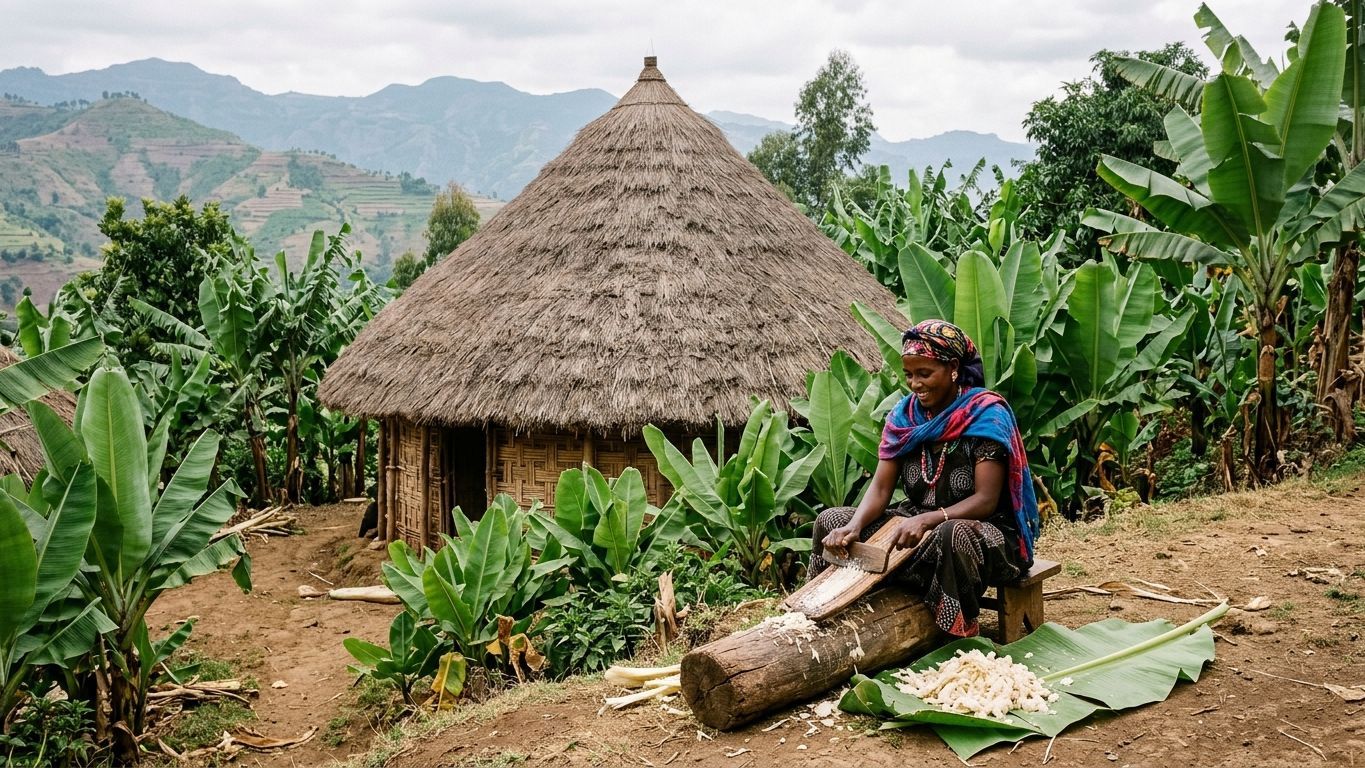
To make kocho, the dense, slightly sour flatbread, the pulp of the enset stem is scraped, fermented underground for weeks or months, then baked on a griddle. The result keeps for a long time, which helps families through lean seasons. Bulla, a finer starch drawn from the same plant, is cooked into a porridge for children, nursing mothers, and guests of honor.
Kitfo is the dish that carries the Gurage name across Ethiopia. Lean beef is minced very fine, then seasoned with mitmita, a fiery chili blend, and niter kibbeh, a clarified butter infused with spices. It is served warmed lightly (leb leb) or fully raw (tere), often beside kocho, fresh cheese called ayib, and cooked greens.
A proper kitfo meal is more occasion than snack. It appears at weddings, holidays, and the welcome given to visitors, and the quality of the beef and the balance of the spices are matters of real pride. In many Gurage households the meat is bought and prepared the same day, and the niter kibbeh may carry a family's own blend of cardamom, fenugreek, and other spices. If you want the broader context of Ethiopian cooking, pair this with our Ethiopian food guide to injera, wot and must-try dishes.
Traditional Gurage Homes and Craftsmanship
A classic Gurage homestead centers on the sefer, a large circular house with a conical thatched roof and a tall central pole. The design is practical for the highland climate: the thick thatch sheds heavy rain, the round shape resists wind, and a single open interior keeps the family and sometimes livestock warm through cool nights. Enset plants ring the house, so food, building material, and shade all grow within arm's reach.
Gurage builders are respected for this architecture, and their skill has a reputation well beyond the zone. Woven bamboo and wood framing, mud plaster, and carefully layered grass roofing all demand practiced hands. Households also weave baskets, carve wooden tools, and craft the leather and gourd vessels used for serving food and local drinks.
Craft work here is closely tied to daily life rather than made only for display. A well-built sefer can last decades, and skills pass from parents to children. Visitors who tour a village often see the whole cycle at once: enset growing in the yard, kocho fermenting in a pit, and a roof being re-thatched by a work party of neighbors.
Festivals, Community Life, and Gurage Hospitality
Community cooperation is the backbone of Gurage life. Mutual-aid associations handle everything from house building to funerals, and large gatherings mark harvests, weddings, and religious holidays shared with the wider country. The Gurage include both Orthodox Christian and Muslim communities, and major Ethiopian festivals such as Meskel are celebrated with feasting, music, and dancing.
Hospitality is a point of pride. A guest is typically welcomed with kocho and kitfo, strong coffee, and the time to sit and talk. The coffee itself is often prepared as a slow ritual of roasting, grinding, and brewing. Our explainer on the Ethiopian coffee ceremony describes the stages you are likely to witness in a Gurage home.
The hard-working, enterprising reputation of the Gurage is a genuine part of the culture, not a stereotype invented for tourists. Many families split their year between farming the highlands and trading in cities, and that mobility has carried Gurage food, language, and generosity into markets across Ethiopia.
Social ties run deeper than business. Age-sets, extended family networks, and village councils still shape how decisions get made and how disputes are settled. When a family builds a house or faces a loss, neighbors turn up with labor, food, and money through long-standing mutual-aid groups. For a traveler, this web of obligation is easy to feel at a shared meal, where no one eats until the guest has been served first.
Visiting the Gurage Highlands on a Cultural Tour
The Gurage Zone is one of the easiest highland cultures to reach from the capital, sitting roughly a three-hour drive southwest of Addis Ababa toward Wolkite. A typical visit blends a village walk, a demonstration of enset processing, a kitfo-and-kocho meal, and a coffee ceremony with a host family. Because so much of the experience happens inside homes and compounds, a local guide and interpreter make the difference between watching and actually taking part.
A guided cultural journey also solves the practical pieces: road transport on mixed highland tracks, introductions to host families, and timing your visit around a market day or festival. Yenew arranges exactly this kind of itinerary as part of its Ethiopia cultural tours built around living traditions, so you spend your time meeting people rather than untangling logistics.
The best stretch for highland travel is the long dry season, when roads are firm and village life is easy to join. If you are still shaping your dates, start with a quick cultural day trip out of Addis to taste authentic kitfo at its source, then decide whether to build a longer southern-highlands loop around it.
Frequently asked questions
Who are the Gurage people?
The Gurage are an Ethiopian ethnic group from the central highlands south of Addis Ababa. They speak Gurage languages of the Semitic family, farm enset, and are known across Ethiopia for hard work, trade, and hospitality.
What is kitfo?
Kitfo is finely minced raw or lightly warmed beef seasoned with mitmita chili and niter kibbeh, a spiced clarified butter. It is the signature Gurage dish and is usually eaten with kocho, the dense flatbread made from enset.
What is enset, the false banana?
Enset is a banana-like plant grown for its starchy stem and root rather than fruit. Ethiopians ferment the pulp into kocho and bulla. Enset is a staple food for roughly 20 million people in southern and central Ethiopia.
Where is the Gurage Zone and how do I visit?
The Gurage Zone lies in Ethiopia's central highlands, with Wolkite as its administrative center, roughly a three-hour drive southwest of Addis Ababa. A guided cultural tour is the easiest way to arrange transport, homestays, and a local interpreter.
