Key takeaways
- Fewer than 500 adult Ethiopian wolves survive, across six isolated mountain ranges, making it Africa's most endangered carnivore (WildCRU, Oxford).
- The Bale Mountains hold the largest stronghold, with more than half the global population in one park.
- Rodents account for 96% of all prey occurrences in the wolf's diet, tying its survival to the Afroalpine grasslands above 3,200 metres.
- Rabies and canine distemper carried by domestic dogs are the biggest threats, driving repeated population crashes in the Bale Mountains.
- Guided treks in the Bale Mountains, especially the Sanetti Plateau, offer the best realistic chance of a wild sighting.
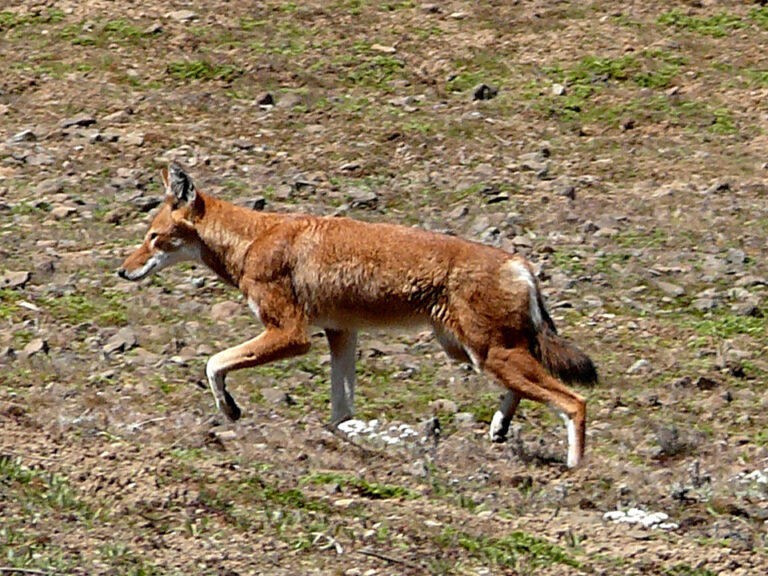
Fewer than 500 adult Ethiopian wolves remain on Earth, scattered across six isolated mountain ranges in the Ethiopian highlands. That makes this russet-coated hunter the rarest canid in the world and Africa's most endangered carnivore, found nowhere else on the planet.
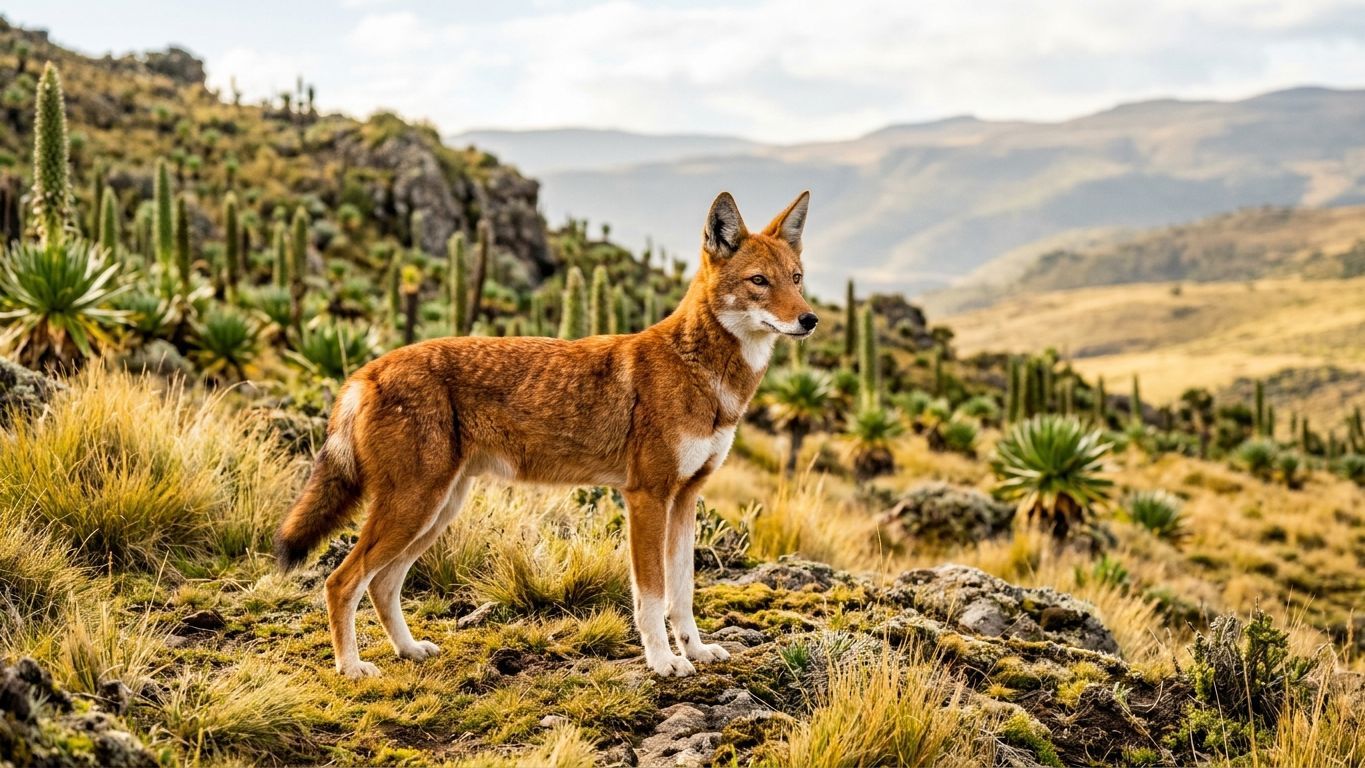
The Ethiopian wolf looks more like a long-legged fox than the grey wolves of the northern hemisphere. It lives only in a sliver of cold, high grassland above the tree line, a landscape most travellers never imagine when they picture Africa. For anyone drawn to rare wildlife, few sightings carry the weight of watching one trot across an open plateau at dawn.
Where Can You Find Ethiopian Wolves?
Ethiopian wolves live only in the Afroalpine grasslands of Ethiopia's highlands, with the Bale Mountains holding by far the largest population. That single park shelters more than half of every Ethiopian wolf alive, which is why it anchors almost every serious search.
The Bale Mountains National Park sits in the south, and its Sanetti Plateau is the single best place to look. The terrain is open and treeless, so a wolf hunting across the grass is visible from a long way off. Early morning and late afternoon are the active hours.
Farther north, the Simien Mountains National Park holds a much smaller group. Sightings there are far rarer, but the scenery of jagged escarpments and gelada baboon troops makes the search rewarding in its own right. Most travellers chasing a Bale Mountains wolf sighting treat the Simien leg as a scenic bonus rather than a wolf guarantee.
Smaller enclaves survive in the Arsi Mountains and a handful of other highland pockets. In total the species clings to just six or seven separated ranges, each one an island of suitable habitat surrounded by farmland.
What Makes It Africa's Most Endangered Carnivore?
The Ethiopian wolf is listed as Endangered on the IUCN Red List, with fewer than 500 adults left in the wild (WildCRU, Oxford University). No other carnivore on the continent survives in such small numbers across so few places.
Several factors stack against the species. Its habitat is naturally tiny, confined to the coldest, highest ground. As human settlement and farming push up the slopes, that ground keeps shrinking. A wolf population split into six fragments cannot easily mix, so each group faces its own risk of local extinction.
Disease is the sharpest danger. Domestic dogs living alongside highland communities carry rabies and canine distemper, and both spread quickly through wolf packs that share territory. Repeated outbreaks have cut deeply into the Bale Mountains population since the late 2000s. A single epidemic can wipe out a large share of a subpopulation in weeks.
Breeding adds another constraint. Only a portion of dominant females breed successfully in any given year, which slows recovery after a crash. With so few animals and such narrow habitat, the margin for error is almost gone.
Ethiopia is often associated with big, famous predators, and many visitors ask whether the country still has lions or even tigers. Our guide on what wildlife to expect in Ethiopia sets realistic expectations, and the plain truth is that the wolf, not any big cat, is the highland's true rarity.
How Do Ethiopian Wolves Live in the Afroalpine Zone?
Ethiopian wolves are rodent specialists, and rodents account for 96% of all prey occurrences in their diet (International Wolf Center). Their whole way of life is built around hunting small mammals in cold, open grassland.
The habitat itself is striking. These wolves occupy Afroalpine grasslands and heathlands at roughly 3,200 to 4,500 metres, far above the tree line. Days can be warm and bright, nights drop below freezing, and giant lobelia plants rise like candelabra across the plains.
Eighty-seven percent of the rodents they catch come from three species: the giant mole-rat, Blick's grass rat, and the black-clawed brush-furred rat. A wolf will stalk slowly through the tussocks, then pounce on a burrow entrance, a hunting style closer to a fox than a pack predator.
Socially, they are unusual. Ethiopian wolves live in family packs that hold a shared territory, yet they hunt alone because their rodent prey is too small to share. The packs gather for social bonds and to defend their patch, then scatter across the grass to feed. That combination of tight family life and solo hunting is rare among the world's canids.
What Conservation Efforts Protect the Species?
Conservation focuses on stopping disease, since rabies and distemper from domestic dogs drive the steepest population crashes. The Ethiopian Wolf Conservation Programme, run with Oxford's wildlife research unit, has led this work for decades.
Vaccination is the front line. Teams vaccinate domestic dogs in highland communities to cut the reservoir of infection, and they have also trialled oral rabies vaccines delivered directly to wild wolves. When an outbreak hits, rapid response can mean the difference between a dented pack and a lost one.
Habitat protection matters just as much. Both the Bale and Simien Mountains are national parks, which gives the wolves legal shelter and draws the tourism income that helps fund monitoring. Working with farming communities to manage grazing keeps the fragile grassland intact.
Visitors play a quiet role too. Park fees and guided-tour spending support rangers and research, so a well-run trip is also a small contribution to keeping the species alive. Responsible operators brief guests to keep their distance and never feed or crowd the animals.
Which Trekking Tours Give You the Best Chance?
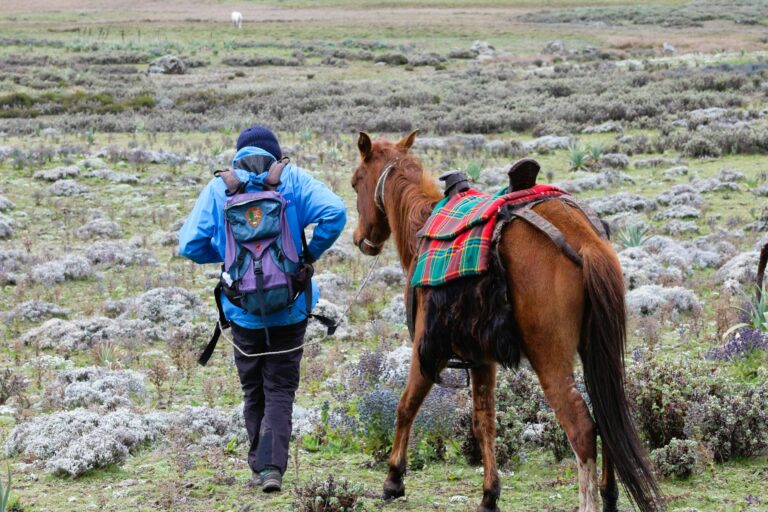
A guided multi-day trek across the Bale Mountains gives the strongest realistic chance of a sighting, because the park holds the bulk of the world's wolves in open terrain. Local guides know the territories and read the morning activity patterns.
The classic route centres on the Sanetti Plateau, often reached from the town of Dinsho and the park headquarters. A typical itinerary spends two or three days at altitude, with dawn drives or walks across the plateau when wolves are most active. Patience and an early start matter more than luck.
The Simien Mountains suit travellers who want dramatic scenery alongside a slim wolf chance, plus near-certain geladas and ibex. A slower, higher-comfort version of either trek combines the highlands with warm lodges and private guiding, which suits visitors who want the altitude without a rough camp.
At GishAbay Ethiopia Tour, we build Bale Mountains itineraries around the wolf's active hours and pair them with the culture and landscapes of the wider region. If a wild Ethiopian wolf sits near the top of your travel list, start by talking through a tailored highland trek with our team, then lock in the dry-season dates that give you the clearest shot.
Frequently asked questions
How many Ethiopian wolves are left?
Fewer than 500 adults remain across six isolated mountain ranges, according to WildCRU at Oxford University. This makes the Ethiopian wolf the rarest canid in the world and Africa's most endangered carnivore.
Where is the best place to see an Ethiopian wolf?
The Bale Mountains National Park, particularly the Sanetti Plateau, offers the best chance. It holds more than half the global population in open Afroalpine terrain where the wolves are easier to spot.
What do Ethiopian wolves eat?
They are rodent specialists. Rodents make up 96% of all prey occurrences in their diet, with the giant mole-rat, Blick's grass rat, and black-clawed brush-furred rat the most common targets.
Are Ethiopian wolves dangerous to humans?
No. Ethiopian wolves are small, shy canids that hunt rodents and avoid people. They pose no threat to visitors and will usually keep their distance during a sighting.
What is the best time of year to visit the Bale Mountains?
The dry months from October to March give the clearest conditions for trekking and wildlife viewing on the high plateau, with better road access and open sightlines across the grasslands.