Key takeaways
- The Lower Omo Valley in southwestern Ethiopia is home to more than a dozen distinct ethnic groups, including the Mursi, Hamar, Karo, and Daasanach.
- The region is a UNESCO World Heritage Site, inscribed in 1980 for paleontological finds that include some of the earliest known Homo sapiens fossils.
- The dry months from November to March offer the most reliable roads, active markets, and the best chance of witnessing a Hamar bull-jumping ceremony.
- Responsible travel means paying agreed fees for photos, asking before you point a camera, and letting a local guide broker every village visit.
- Most visitors reach the valley on a multi-day overland route south from Arba Minch through Konso and Jinka.
The Omo Valley in southwestern Ethiopia is one of the last places on earth where more than a dozen distinct peoples live largely by their own traditions, from the lip plates of the Mursi to the bull-jumping ceremonies of the Hamar. This guide covers who lives there, when to go, how to travel respectfully, and how to build a realistic overland route through the region.
Following the lower course of the Omo River toward Lake Turkana, the valley is remote, hot, and reached mostly by rough road. That isolation is exactly what has preserved its cultures, and it is also why planning matters more here than in most Ethiopian destinations.
Meet the peoples of the Omo Valley
The Lower Omo is home to more than a dozen ethnic groups, each with its own language, dress, and social customs. A single week of travel can bring you into contact with several of them, sometimes at the same market. A few communities stand out for most visitors.
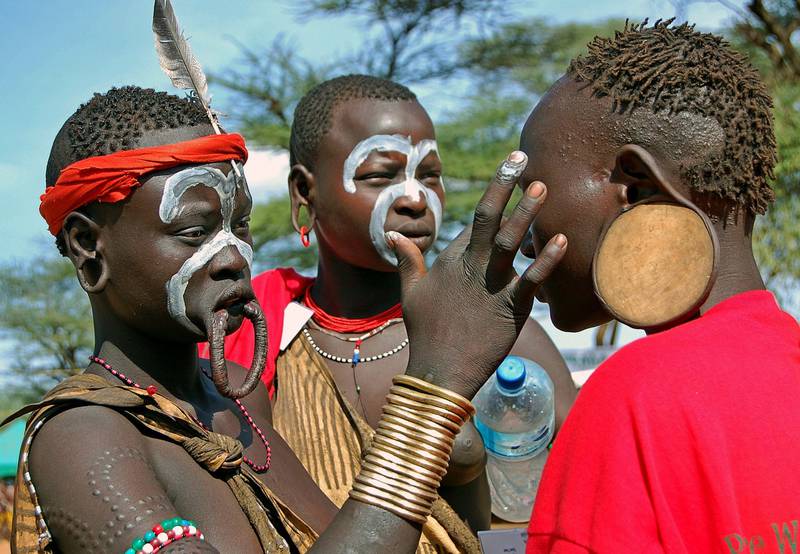
- Mursi. Known worldwide for the clay lip plates worn by some women and for elaborate body painting. The Mursi are cattle herders living in the plains near Mago National Park.
- Hamar. Recognized for their ochre-styled hair, beaded jewelry, and the bull-jumping ceremony that marks a young man's passage to adulthood. Their weekly markets in towns like Turmi and Dimeka are highlights of any trip.
- Karo. One of the smallest groups in the valley, living along the eastern bank of the Omo River. The Karo are celebrated for intricate body and face painting used for ceremonies and daily life.
- Daasanach. A larger, agro-pastoral group living in the arid delta near Lake Turkana, close to the Kenyan border. Their villages are among the most southerly you can reach.
Beyond these, you may encounter the Bana, Tsemay, Ari, and the terraced hillside villages of the Konso, whose cultural landscape is itself a UNESCO World Heritage Site recognized for its dry-stone walls and terraces. The diversity packed into a small area is the reason so many travelers describe the Omo as unlike anywhere else in Africa.
When to visit for markets, ceremonies, and photography
Timing shapes almost everything about an Omo Valley trip. The single most important factor is the weather, because unpaved roads turn to deep mud in the rains.
The dry season from November through March is the most reliable window. Roads are firm, weekly markets are busy, and the light in the early morning and late afternoon is ideal for photography. A second, shorter dry spell often runs from late June into September. The heavy rains from late March into June can leave tracks impassable and villages hard to reach, so most operators avoid those months.
Markets are the easiest cultural encounters to plan around. Each town has its own day, and traders walk in from surrounding villages to buy, sell, and socialize. Dimeka and Turmi are well known for Hamar market days, while Key Afer draws a mix of Bana, Tsemay, and Ari.
Ceremonies are harder to schedule. Hamar bull-jumping, which takes place when a family decides a young man is ready to marry, happens most often in the drier months but is not fixed to a calendar. A good local guide keeps track of which families are preparing and can sometimes secure an invitation, but no operator can guarantee a ceremony on a set date.
Responsible and respectful cultural travel
The Omo Valley has become well known for photography, and that popularity brings real ethical questions. Handled thoughtlessly, a visit can feel extractive. Handled well, it can be a genuine and respectful exchange.
A few practices make the difference:
- Agree on photo fees in advance. In many villages, a small per-photo payment is the accepted custom. Settle the rate through your guide before you start, so no one feels pressured mid-visit.
- Always ask before you photograph. A camera pointed without consent is intrusive anywhere. Ask, wait for a clear yes, and accept no as an answer.
- Slow down. Spending real time in a village, sitting, talking through your guide, and buying a craft directly, produces better encounters than a rushed stop for pictures.
- Follow your guide's lead on customs. Rules about where you can walk, what you can touch, and how you greet elders vary between communities. Your guide is your interpreter for etiquette as much as for language.
Choosing an operator that pays fair fees and maintains long-term relationships with specific villages keeps more of your money in the community and makes each visit less transactional. GishAbay Ethiopia Tour builds its southern itineraries around guides who know these communities personally, which is what turns a photo stop into an actual conversation.
A suggested route from Arba Minch through the lower Omo
Most Omo Valley trips begin in Arba Minch, a town in Ethiopia's Southern Nations region reachable by a short domestic flight or a long drive from Addis Ababa. From there, the classic overland loop heads south and deeper into the valley.
A typical route runs like this:
- Arba Minch to Konso. A half-day drive brings you to the Konso highlands, known for their terraced fields and walled villages. This is a natural first cultural stop.
- Konso to Jinka. Jinka is the main hub for the central valley and the gateway to the Mursi. It also has a small but worthwhile museum on the region's peoples.
- Mago National Park and Mursi villages. From Jinka, a rough 4WD track leads into Mago to visit Mursi communities. Set aside a full day.
- Turmi and Hamar country. Continue south to Turmi, the best base for Hamar markets at Dimeka and for the chance of a bull-jumping ceremony.
- Omorate and the Daasanach. A day trip toward the Kenyan border reaches Omorate, where a short boat crossing of the Omo River leads to Daasanach villages.
Plan on roughly five to eight days for a satisfying loop, plus travel time to and from Addis Ababa. The distances look modest on a map, but slow roads and river crossings mean a 4WD vehicle and unhurried scheduling are essential.
The deep history under your feet
The Omo Valley is not only a living cultural landscape. It is one of the most important paleontological sites in the world. The Lower Valley of the Omo was inscribed as a UNESCO World Heritage Site in 1980, recognizing a record of human origins that few places can match.
According to the African World Heritage Sites organization, the area has yielded some of the earliest known Homo sapiens fossils, dated to roughly 195,000 years ago, alongside stone tools that reach back more than 2.5 million years. Standing in the valley, you are moving through one of the deepest continuous records of human presence anywhere on the planet.
How to arrange a guided Omo Valley Ethiopia tour
The Omo Valley rewards a guided approach more than almost any destination in Ethiopia. Permits, translation across several languages, village introductions, and the logistics of 4WD travel in a roadless region are difficult to manage independently, and getting them wrong can waste days.
A capable operator handles the vehicle and driver, arranges photography and entry fees, coordinates with specific villages, and reads the shifting calendar of markets and ceremonies. Working with local guides also means you arrive as an introduced guest rather than an unannounced stranger, which changes the tone of every encounter.
GishAbay Ethiopia Tour designs southern itineraries around exactly this kind of relationship-led travel, pairing international visitors with guides who live and work in the region. That local grounding is what lets a trip flex around a bull-jumping ceremony or an extra market day when the opportunity appears.
If the Omo Valley is on your list, start by deciding on your travel window in the November-to-March dry season, then contact a local operator to shape a route that fits it. Booking early gives your guides time to track which ceremonies may fall within your dates, and that lead time is often the difference between seeing the valley and truly experiencing it.
Frequently asked questions
Where is the Omo Valley in Ethiopia?
The Omo Valley sits in southwestern Ethiopia, following the lower course of the Omo River toward Lake Turkana near the Kenyan and South Sudanese borders. Most trips reach it by road from Arba Minch.
What tribes live in the Omo Valley?
The Lower Omo is home to more than a dozen ethnic groups. The best known to visitors are the Mursi, Hamar, Karo, Daasanach, Bana, and Konso, each with its own language and customs.
When is the best time to visit the Omo Valley?
The dry season from November through March is best for road access, weekly markets, and ceremonies. Heavy rains from late March into June can make tracks impassable.
Is it safe and ethical to photograph the Omo Valley tribes?
Photography is common but comes with etiquette. Agree on a small per-photo fee in advance, always ask permission, and work through a local guide who understands the customs of each community.
How do I arrange a guided Omo Valley tour?
Book through an operator with local guides and vehicles, such as GishAbay Ethiopia Tour. A guided trip handles permits, translation, village introductions, and the 4WD logistics the region requires.